 ×
Selecting Lithium Disilicate Beyond a Single Strength or Fit Number
Lithium disilicate is often discussed as if it were one material with one workflow.
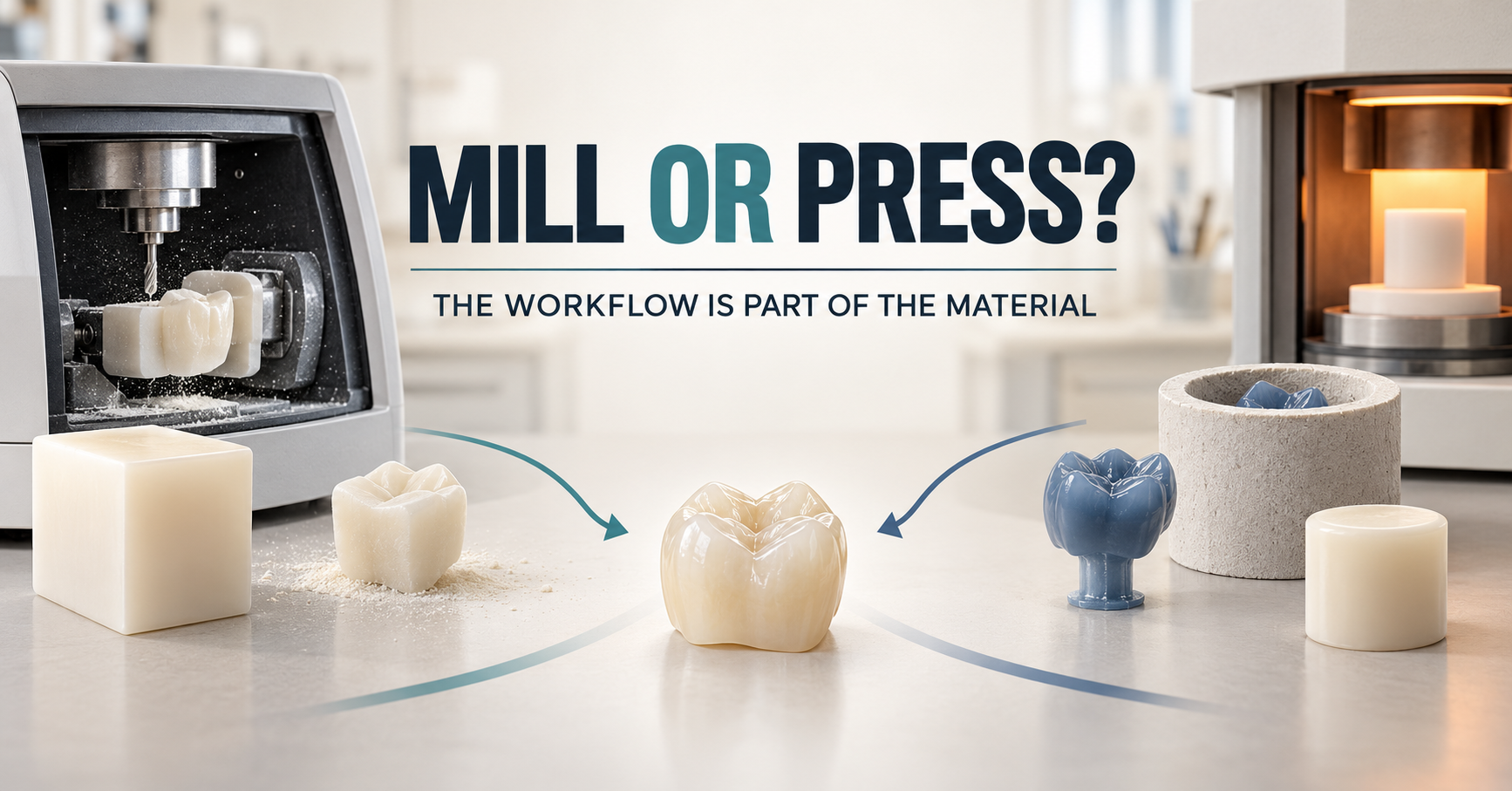
In practice, selecting a CAD/CAM block or a pressable ingot changes much more than the form in which the ceramic arrives. It changes how the restoration is designed, fabricated, handled, fired, finished, remade, and documented.
This is why the question “Is milled or pressed lithium disilicate better?” rarely produces a useful answer.
A better question is:
Which workflow gives this laboratory the most controlled route from case information to an acceptable restoration?
The answer can vary by restoration geometry, available equipment, production volume, technician experience, and the laboratory’s quality-control system.
The same material family can create two different processes
A typical milling workflow begins with a digital design. The restoration is positioned in a block, toolpaths are calculated, and the unit is machined. Depending on the specific ceramic system, it may then require a defined crystallization or post-milling firing cycle before characterization and finishing.
A typical pressing workflow begins with a wax or resin pattern. The pattern is sprued and invested, the mold is created through burnout, and a heated ingot is pressed into the space. The restoration is then divested, separated, finished, and characterized.
Both routes can produce a lithium-disilicate restoration. But they introduce different variables.
For milling, these may include:
For pressing, they may include:
The material cannot be evaluated independently from these process steps.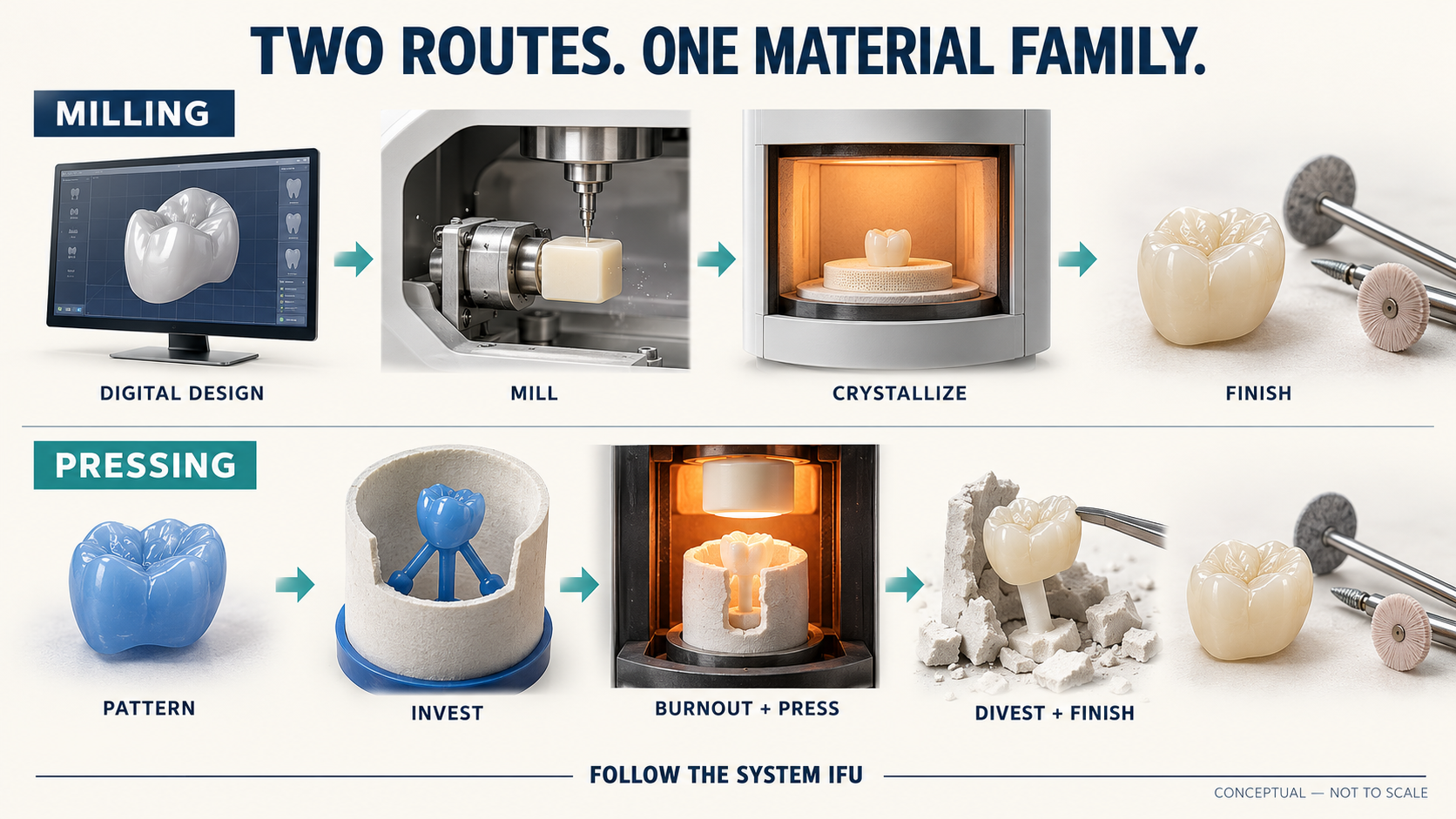
Fit studies do not identify a universal winner
Marginal and internal fit are frequently used to compare the two routes. Published results, however, depend heavily on the systems and methods being tested.
One in-vitro study reported smaller marginal gaps for pressed lithium-disilicate crowns than for the tested CAD/CAM crowns.
Another study found no significant difference between the tested hot-pressed and CAD/CAM techniques, with both groups producing marginal measurements within the study’s stated acceptable range.
More recent evidence remains similarly dependent on the specific system and measurement method. A 2026 systematic review concluded that the available evidence did not demonstrate a consistent difference in internal fit between heat-pressed and CAD/CAM-milled lithium-disilicate crowns.
These findings should not be read as contradictions that make research useless. They show why a laboratory should not convert one study into a universal production rule.
Fit is an output of the complete workflow.
Strength numbers require the same caution
Mechanical comparisons can also change with specimen geometry, translucency, surface condition, processing, and testing method.
In one study comparing heat-pressed and CAD/CAM lithium disilicate at several translucency levels, the overall flexural-strength means of the pressed and CAD groups were not significantly different. Differences were identified among certain translucencies within the CAD group.
Other laboratory studies using finished crowns, different surfaces, or different loading methods have reported route-related differences.
The responsible conclusion is not that manufacturing technique never matters. It is that a strength value from one specimen and protocol cannot independently select the best workflow for every restoration.
Before comparing numbers, laboratories and buyers should ask:
Without the test conditions, the number is incomplete.
Geometry changes the practical decision
Milling is influenced by tool diameter and access. A bur cannot reproduce an internal feature that is smaller or sharper than the tool can reach. CAM software may compensate by modifying the geometry, but that compensation can affect the internal surface or require manual adjustment.
This does not mean that pressing has no geometric constraints.
A pressed restoration still depends on the quality of its pattern, spruing, investment, pressing, and divesting. A geometry that is difficult to mill may also be difficult to invest, press, recover, or finish without damage.
The relevant question is not which method is theoretically unrestricted. Neither is.
The question is which route can reproduce the specific geometry with the fewest uncontrolled corrections in the laboratory’s own process.
Single-unit speed and batch organization are different advantages
A digital block workflow can be practical when a laboratory needs to manufacture or remake one unit without rebuilding an entire pressing batch. The original design file may also simplify repeating the geometry, although the new unit still requires the complete validated manufacturing and finishing process.
Pressing may be efficient when several compatible patterns can be organized into one controlled batch and the laboratory already has experienced technicians, established investment procedures, and suitable furnace capacity.
Neither advantage is automatic.
A milling machine with a long queue may not provide fast turnaround. A press furnace loaded with only one urgent unit may not provide good batch efficiency. A highly automated step may still require substantial setup and finishing labor.
Laboratories should separate:
Otherwise, “fast” may describe only one step rather than the total production route.
Consider the remake path before the first case fails
A remake exposes workflow differences very quickly.
With a milled restoration, the laboratory may be able to reopen the digital file, review the design and CAM strategy, and mill another block. With a pressed restoration, the laboratory may need to reproduce or reprint the pattern, sprue, invest, burn out, press, and divest again.
That does not automatically make the milled remake less expensive. Block cost, machine availability, tool wear, firing, technician time, and the original reason for failure still matter.
The important point is to document the remake path before using material price alone to compare systems.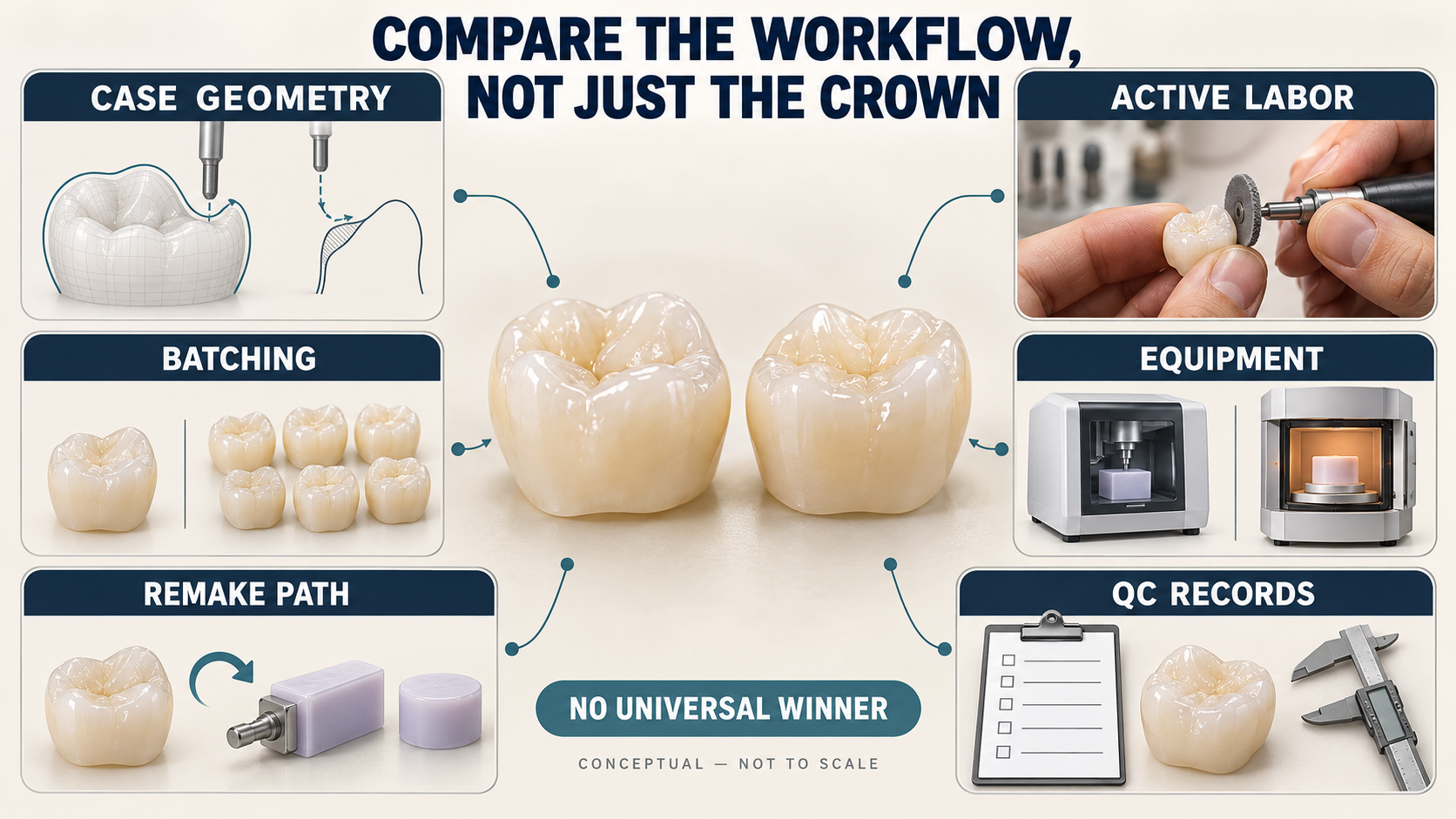
Compare both routes inside your own laboratory
A useful internal comparison does not need fabricated performance claims or a large clinical study.
Select one common restoration category and define the acceptance criteria in advance. For each route, record:
Follow the instructions for each specific system rather than forcing both materials through identical firing or handling conditions.
The objective is not to make the workflows artificially identical. It is to compare them fairly under their intended processing conditions.
Procurement should include workflow compatibility
For distributors and purchasing teams, the product format affects more than shelf space.
Before adding a lithium-disilicate system, clarify:
A material can have an attractive purchase price and still be a poor operational fit if it requires equipment, consumables, skills, or inventory that the laboratory does not use efficiently.
There is no need to choose one route for every case
A digitally oriented laboratory may favor blocks for routine production while retaining pressing for selected geometries or batch types. Another laboratory may have a highly controlled pressing department and use milling for urgent single units or digitally integrated cases.
The strongest workflow is often not the one with the most impressive isolated specification. It is the one the laboratory can execute, inspect, document, and repeat consistently.
Before choosing between a block and an ingot, map the complete route—from design or pattern to the accepted restoration. That process map will usually reveal more than one comparison number.


 EN

