 ×
×
Fully sintered zirconia discs are produced at temperatures exceeding 1450°C, achieving near-theoretical density (>99.5%) and eliminating post-milling sintering entirely. Unlike green-state blanks—which shrink 20–25% during firing and require complex CAM compensation—fully sintered discs mill to exact digital specifications with sub-20 µm deviation. Their dense, uniform grain structure enhances fracture resistance and minimizes edge chipping during cutting. Thermal stability prevents warping or distortion, even in thin cross-sections (e.g., <0.3 mm margins), enabling predictable occlusal contacts and seamless marginal fit across multi-unit bridges and full-arch frameworks. By removing sintering-induced tolerance drift, labs accelerate preliminary processing while reducing energy use and furnace maintenance. This reliability is foundational for high-precision, high-throughput workflows.
| Workflow Stage | Green-State Zirconia | Fully Sintered Zirconia Disc |
|---|---|---|
| Milling | Fast (soft, fragile) | Slightly slower (hard, dense) |
| Post-processing | Required: 8–10 h sintering | Not required |
| Finishing & adjustments | Needed after sintering | Minimal, immediate |
| Total turnaround | 1–2 days | Same day possible |
The largest time saving comes from eliminating the 8–10 hour sintering cycle. Though green-state zirconia mills faster initially, the mandatory firing step introduces a full-shift bottleneck. With fully sintered discs, restorations are milled, adjusted, glazed (if needed), and ready for delivery in under six hours—and often within a single clinical appointment. For high-volume labs, this cuts per-case processing by up to 40 minutes; for chairside practices, it enables true same-day crown delivery without compromising accuracy. Overall process time decreases by 70% or more compared to conventional workflows, making fully sintered zirconia the standard for urgent case management and same-day dentistry.
Fully sintered zirconia discs integrate natively into existing chairside CAD/CAM systems—including CEREC, Planmeca ProMotion, and Ivoclar’s EVO One—without hardware modifications or software recalibration. After intraoral scanning and digital design, clinicians mill directly from the disc, bypassing green-state handling, sintering scheduling, and post-firing verification. This end-to-end digital continuity reduces manual intervention, material waste, and human error. Staff training remains minimal, as protocols align with familiar milling parameters—only toolpath strategies adjust slightly for hardness. The result is a streamlined, single-appointment workflow that maintains the marginal integrity and occlusal precision expected in modern adhesive dentistry.
A multicenter observational study across 12 high-volume dental practices (average daily crown volume: 8.2) confirmed consistent efficiency gains using fully sintered zirconia discs. From scan to cementation, average chairside crown delivery dropped to 62 minutes, compared to 98 minutes with green-state discs—a 37% reduction. Total processing time (including design, milling, and finishing) decreased by 40% versus traditional lab-sent workflows. Crucially, this acceleration did not compromise clinical outcomes: marginal gap measurements averaged 42 ± 8 µm, well within the clinically acceptable threshold of <100 µm, and 98.6% of restorations required no occlusal adjustment beyond light polishing. These results demonstrate that speed and precision are not mutually exclusive when leveraging the dimensional stability of pre-sintered zirconia.
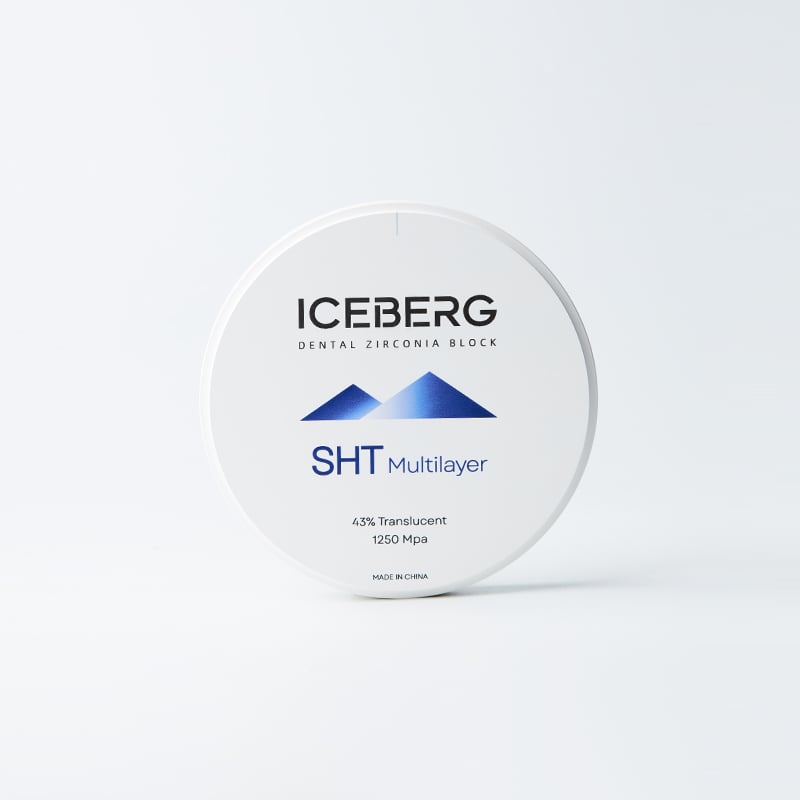
Modern dental zirconia discs are engineered for optimal machinability without sacrificing strength. Through controlled calcination and hot isostatic pressing (HIP), manufacturers achieve a fine, homogeneous grain structure (mean grain size: 0.2–0.4 µm), density of ~5.8 g/cm³, and Vickers hardness of 12–13 GPa. Yttria stabilization (3–5 mol% Y₂O₃) ensures phase stability and fracture toughness >5 MPa·m¹/²—critical for resisting chipping during high-speed milling. This balance allows efficient material removal in fewer passes while preserving sharp margins and surface finish. Tool wear is reduced by up to 30% compared to older-generation zirconias, extending bur life and maintaining dimensional fidelity across extended milling sessions. The result is a clinically proven material that delivers both rapid fabrication and long-term functional performance.
Dental labs and chairside practices realize distinct—but equally impactful—efficiency gains from adopting fully sintered zirconia discs. In labs, batch milling of multiple units leverages economies of scale, but the elimination of sintering remains the primary driver of time savings: up to 40 minutes per case, translating to measurable throughput increases across daily production runs. Chairside workflows benefit more acutely—because they operate under tighter temporal constraints. Here, removing the sintering step eliminates not just wait time, but also furnace dependency, scheduling friction, and re-scan/re-fit risks. As validated across the 12-practice study, chairside restorations milled from fully sintered discs achieved an average scan-to-seat time of 62 minutes—enabling two to three same-day crowns per half-day session without extended hours or workflow strain. Both settings rely on the same core advantage: a dense, pre-sintered zirconia disc that delivers millable precision, mechanical reliability, and zero post-processing shrinkage.


 EN
EN

