 ×
Choosing Zirconia for the Substrate, Not the Catalogue
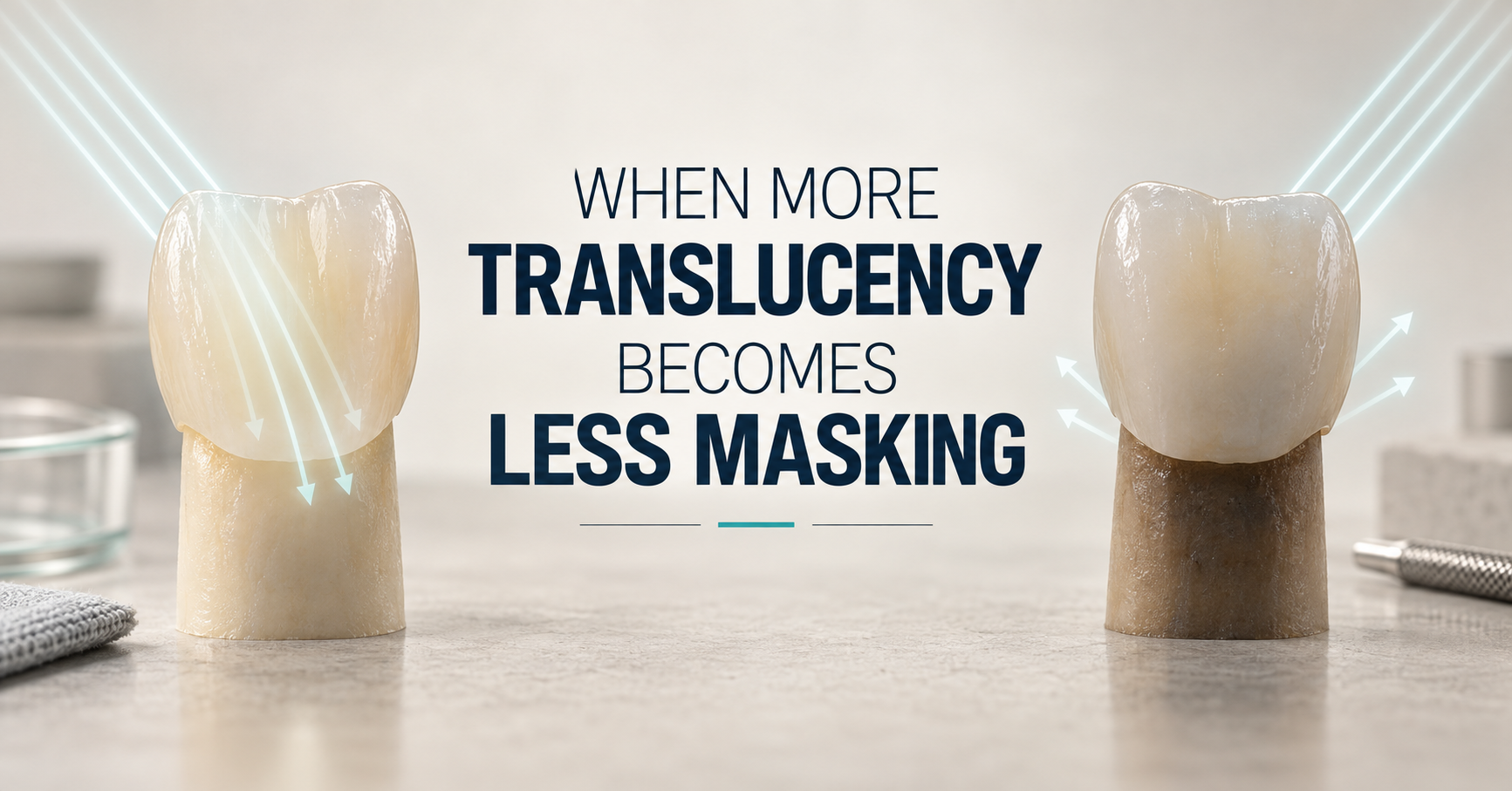
For years, the dental materials market has treated higher translucency as a straightforward upgrade. The language is familiar: more light transmission, a more natural appearance, and less need for veneering.
But translucency is not automatically an advantage in every case.
The same property that allows light to enter a restoration can also allow the underlying preparation, core, or abutment to influence its final appearance. When the substrate is light and uniform, that interaction may be helpful. When it is dark, discolored, metallic, or uneven, the result can be very different.
This does not mean that highly translucent zirconia is unsuitable. It means that translucency must be selected for the case—not simply ranked on a catalogue.
Masking is not the opposite of aesthetics
Aesthetic performance is often discussed as if translucency were the primary objective. In reality, a restoration may need to perform two competing optical tasks:
Increasing the first function can reduce the second.
A laboratory study comparing four translucent monolithic zirconias found that masking performance was significantly influenced by the material, ceramic thickness, substrate color, and glazing condition. In other words, the name of the zirconia category alone did not predict the result. The complete test condition mattered.
Masking should therefore be understood as a functional optical property—not as evidence that a material is old-fashioned or insufficiently aesthetic.
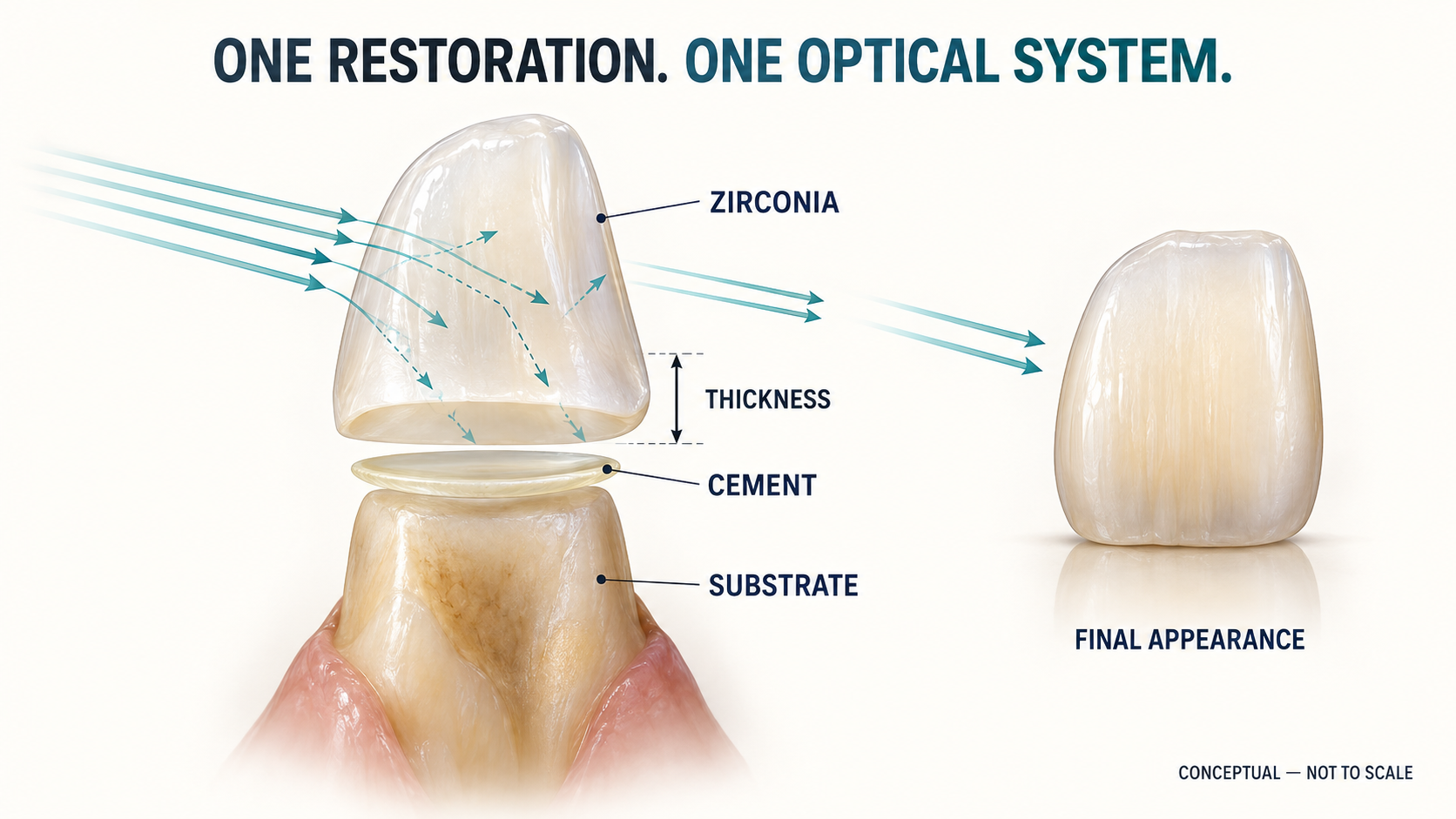
The restoration is an optical stack
The final appearance of a crown is not produced by the zirconia blank alone.
Light first interacts with the external surface and surface texture. It then travels through zirconia of varying thickness, reaches the cement interface, interacts with the underlying preparation, and may be reflected back through the restoration.
The visible result is created by the whole stack:
Surface finish + zirconia shade and structure + local thickness + cement layer + substrate
This is why the same zirconia can appear different when placed on a light die, a dark preparation, a composite core, or a metal-supported foundation. It is also why a sample observed in the hand may not predict its appearance after seating.
The question should not only be:
Which zirconia is more translucent?
A more useful question is:
How much substrate influence can this restoration tolerate?
Thickness is not one number
Thickness is one of the most important variables, but it is easy to oversimplify.
A crown does not have one uniform thickness. Its cervical, facial, proximal, and incisal regions may differ substantially. Even if the digital design reports an acceptable minimum, a thin cervical area may behave differently from a thicker central region.
In an in-vitro study of anatomic-contour zirconia, translucency and transmitted light decreased as specimen thickness increased. Material type and shade also affected the measurements.
This does not provide one universal thickness at which every zirconia will mask every substrate. The tested values belong to the tested materials and conditions.
For practical material selection, the laboratory should consider the thinnest visually critical area—not only the average thickness or the thickest part of the restoration.
If the substrate is dark and the cervical wall is thin, selecting the most translucent available zirconia may create an optical problem that characterization cannot fully correct.
Cement can influence the system—but it is not a rescue plan
Cement shade and opacity are sometimes treated as last-minute tools for correcting an unsuitable material choice.
That approach is risky.
One study of high-translucency zirconia reported interactions among zirconia shade, thickness, substrate type, and try-in paste shade. Another investigation using different zirconia systems found no significant effect from changing between the tested resin-cement shades.
The difference between these findings is useful: the influence of cement is system-dependent.
Cement may contribute to fine adjustment in some combinations, but a laboratory should not assume that an opaque cement will reliably compensate for insufficient masking. The material, available thickness, substrate, and compatible cementation protocol should be considered together before production begins.
Five questions to ask before selecting the blank
For cases where background influence may matter, a short intake checklist can prevent a long remake discussion.
1. What is underneath the restoration?
Natural dentin, a tooth-colored composite core, severe discoloration, a metal post and core, or an implant component do not present the same optical situation.
2. Where is the darkest area?
A single stump-shade description may not show whether the discoloration is uniform or concentrated cervically.
3. What thickness is actually available?
Review the local design, especially the cervical and facial areas. Do not assume that the nominal crown thickness represents the entire restoration.
4. What is the visual target? The laboratory needs more than an A-shade designation. Target value, neighboring teeth, surface texture, and the desired degree of incisal light transmission all matter.
5. Has the cementation approach been considered?
The laboratory does not need to prescribe the clinical protocol, but material selection should not be separated from the cement system and substrate information.
A calibrated preparation photograph with a suitable shade reference can improve communication, although photography should not be treated as a substitute for controlled color measurement.
Compare materials under controlled conditions
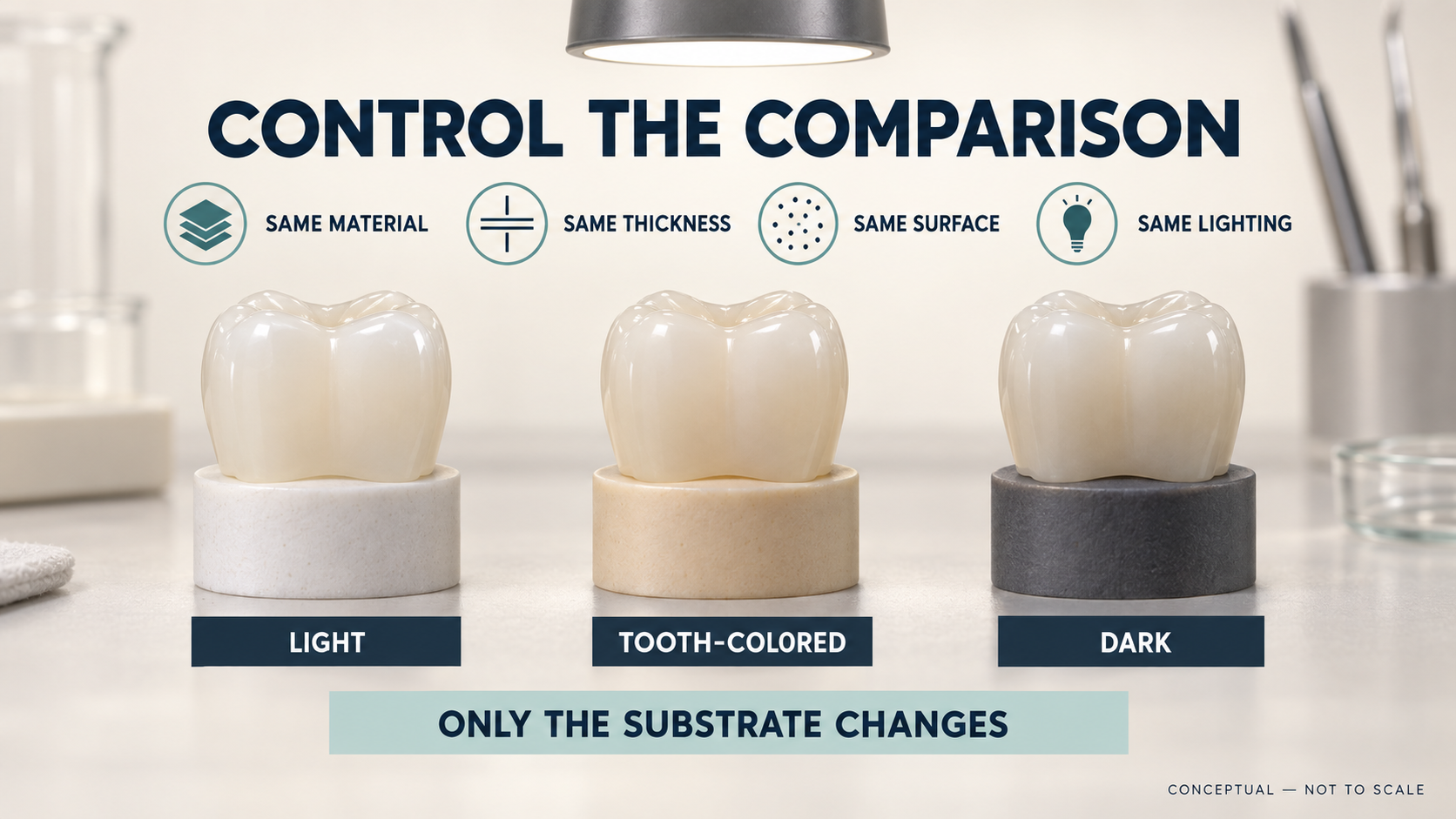
A meaningful masking comparison changes one variable at a time.
If a laboratory wants to compare two zirconias, the samples should use the same:
When evaluating substrate influence, keep the zirconia sample unchanged and vary only the background. Light, tooth-colored, and dark standardized dies can reveal how strongly the substrate affects the apparent restoration.
If one sample is thicker, more highly polished, photographed under different lighting, or placed against a different background, the comparison may look convincing but explain very little.
A white-and-black background test can be useful for relative translucency measurements. It should not, however, be presented as a direct prediction of every clinical case.
A better selection principle
The goal is not to choose the least translucent material whenever the substrate is dark. Nor is it to choose the most translucent material whenever aesthetics are important.
The goal is to match optical behavior to the complete case.
A light, uniform substrate with adequate restorative space may support a more translucent option. A moderately discolored substrate may require a carefully balanced material and a controlled try-in. A severely discolored or metallic foundation—particularly where space is limited—may require greater masking, a revised design, or an alternative restorative strategy discussed with the clinician.
When incisal vitality and cervical masking pull in different directions, there may be no single-number solution. Material architecture, local thickness, coloring strategy, surface treatment, and clinical foundation all become part of the decision.
From a manufacturing perspective, “more translucent” should never be the whole recommendation. A responsible material discussion begins with the substrate, the geometry, and the intended result.
If you are evaluating zirconia for a challenging foundation, share the substrate information, minimum available thickness, and aesthetic target with your material partner before selecting the blank. That short conversation is usually more valuable than choosing from a translucency percentage alone.


 EN

