 ×
A Practical Cost Model for Zirconia Laboratories and Distributors
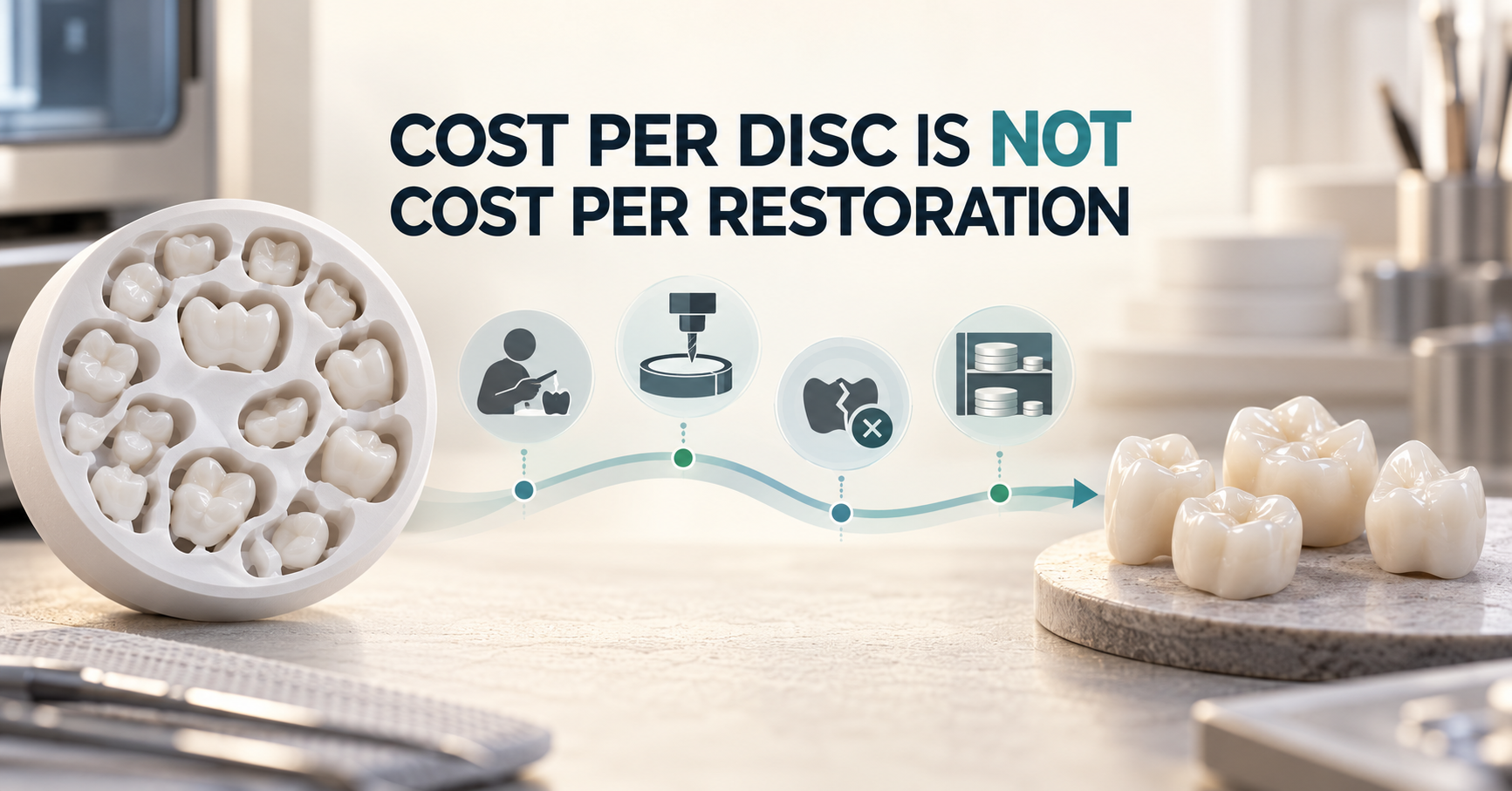
When laboratories compare zirconia materials, the conversation often begins with the price of one disc.
That number is easy to obtain, easy to place in a spreadsheet, and easy to negotiate. It is also incomplete.
A disc does not generate revenue simply because it enters the laboratory. It must be nested, milled, separated, sintered, finished, inspected, and accepted. Some remnants remain useful; others become unusable inventory. Some restorations pass through the workflow once; others consume another milling position, another furnace cycle, and more technician time.
The more useful economic question is therefore not:
How much does one disc cost?
It is:
How much does this workflow cost for each acceptable restoration that we actually ship?
Start with the correct denominator
A low material price can look attractive when cost is divided by the number of units nested. But nesting a restoration is not the same as completing it.
For internal decision-making, a more practical calculation is:
True cost per accepted restoration = total attributable production cost ÷ accepted restorations shipped
“Total attributable production cost” can include material, active labor, equipment capacity, remakes, corrective work, and an appropriate inventory allowance.
This is not intended to replace a laboratory’s formal accounting system. It is a management tool for comparing materials and workflows on the same basis.
The denominator is especially important. If one disc produces many nested units but several require remilling or extensive correction, the apparent material saving can disappear before the case reaches dispatch.
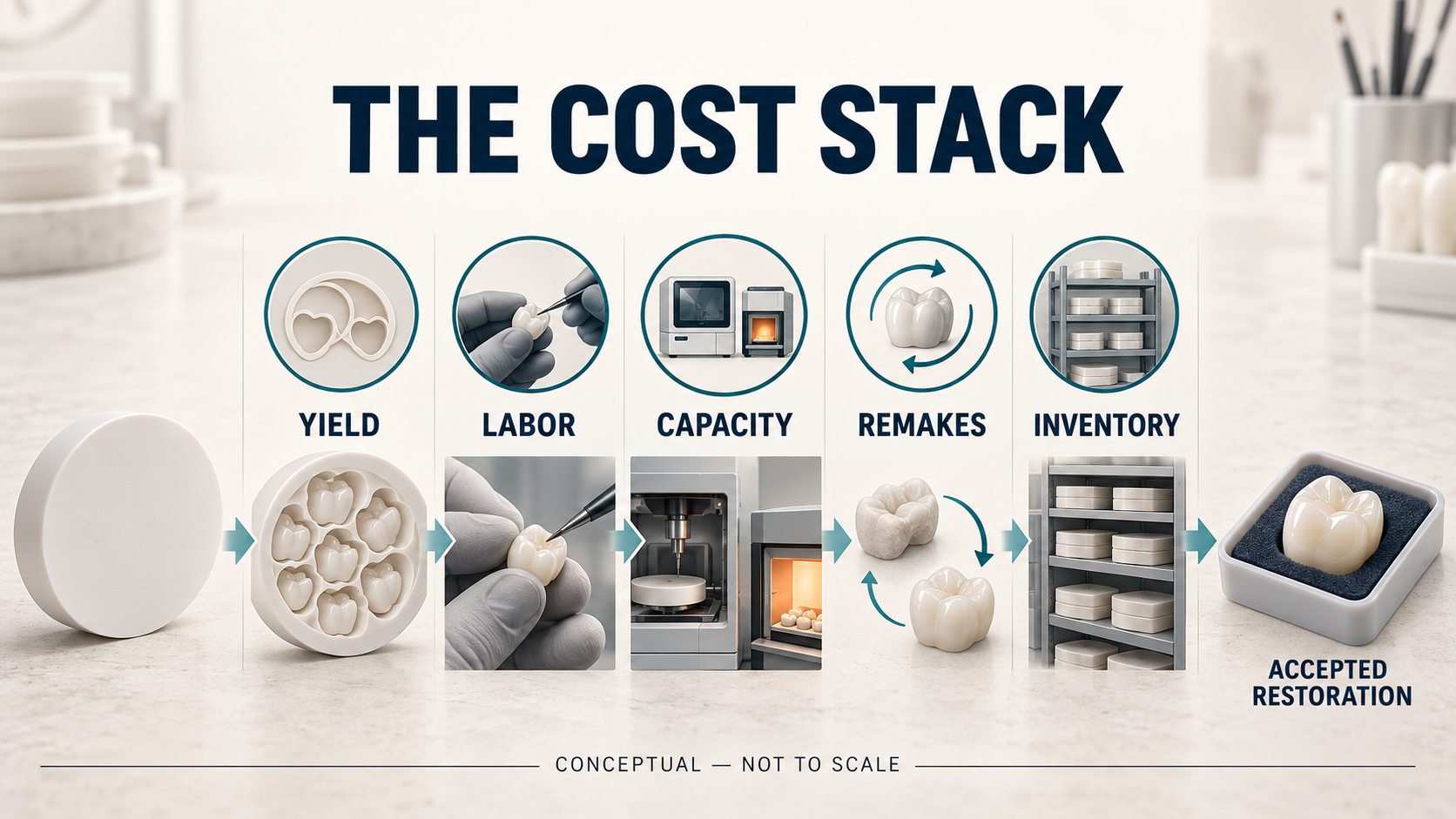
The complete cost stack
The purchase price remains relevant, but it is only the first layer.
1. Material utilization
Useful yield depends on more than the theoretical area of a disc.
Disc height, restoration geometry, connector or support requirements, milling boundaries, previously used areas, and the laboratory’s policy for retaining remnants all influence how much usable value is obtained.
A remaining section of zirconia should not automatically be counted as either waste or savings. It has value only if the laboratory can identify, store, retrieve, and use it in an appropriate future case.
2. Active technician labor
Machine time and technician time are different costs.
A technician may spend active time preparing CAM files, selecting the correct disc, changing tools, loading the machine, separating units, smoothing connectors, applying color, finishing surfaces, correcting contacts, and performing quality checks.
A workflow that needs several small manual corrections on every case may appear acceptable when each correction is considered separately. Across a month of production, those minutes become a meaningful cost.
Record active labor instead of assuming that an automated workflow is labor-free.
3. Milling and furnace capacity
Equipment capacity has economic value even when the machine is already owned.
A remill occupies a position that could have been used for a new case. An avoidable furnace cycle consumes scheduled capacity and may affect dispatch planning. Poor batching can create either unnecessary cycles or delays while cases wait for the next suitable load.
Capacity cost does not have to be calculated with a complicated financial model. Laboratories can begin by tracking occupied milling time, furnace cycles, and cases delayed by unavailable capacity.
The objective is to identify where material or process decisions repeatedly consume production slots.
4. Remakes and quality losses
The cost of a remake is not another piece of zirconia alone.
It may include a second CAM setup, more machine time, another furnace position, additional finishing and inspection, schedule disruption, customer communication, and expedited delivery.
Some losses are material-related; others originate in scanning, design, milling tools, handling, sintering, finishing, or incomplete case information. A fair cost system should record the loss first and investigate the cause separately.
Automatically assigning every failure to the material produces unreliable purchasing data. Automatically excluding every failure from the material evaluation is equally unhelpful.
5. Inventory
Each combination of material family, translucency, shade, diameter, and height creates another stock-keeping requirement.
A broad catalogue may be commercially useful, but only if stock movement justifies the range. Slow-moving discs tie up cash, consume storage space, require identification and traceability, and may become difficult to use as product ranges or customer demand change.
For distributors, the same principle applies at a larger scale. A low purchase price is less attractive if minimum order quantities produce months of slow-moving stock.
Inventory cost should therefore be assessed by product family and size—not only by total warehouse value.
Nesting efficiency is not production yield
Laboratories often use “yield” to describe several different things.
Geometric yield describes how many units can be placed in a disc or how much disc area is occupied.
Production yield describes how many units complete milling, sintering, and finishing without remilling or substantial corrective work.
Commercial yield describes how many restorations pass the laboratory’s acceptance criteria and are shipped.
All three measurements are useful, but they should not be confused.
Aggressive nesting can improve geometric utilization, but it must remain within the design, milling, support, and material limitations of the validated workflow. More units on the CAM screen do not automatically mean more accepted restorations.
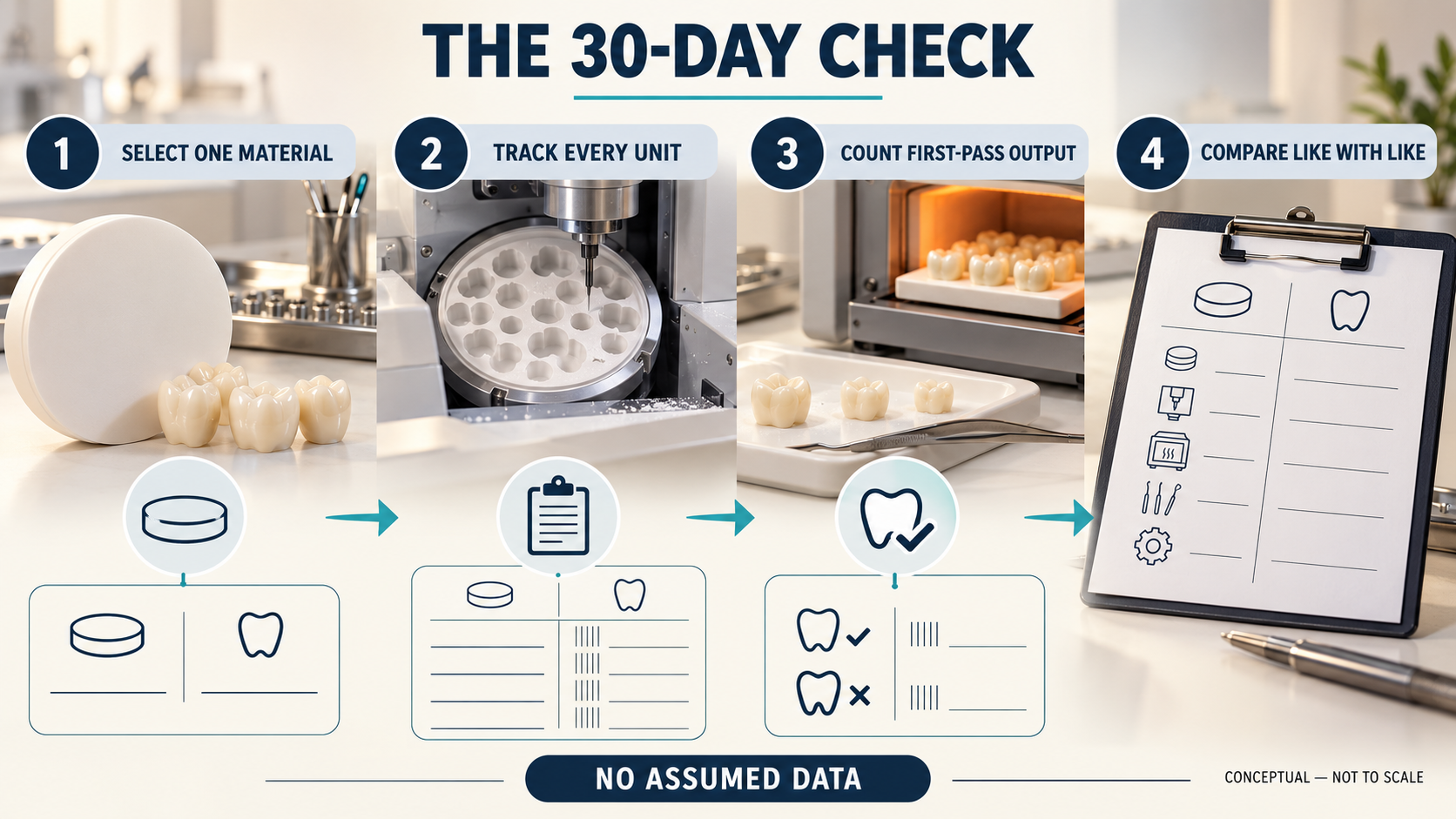
Run a 30-day check
A laboratory does not need a large financial project to improve its costing. Begin with one high-volume material family and one comparable restoration category.
For 30 days, record:
At the end of the period, divide the attributable cost by the number of accepted restorations shipped.
Then examine the difference between nested units and first-pass accepted units. That gap is often more informative than the disc price itself.
Published research also shows why laboratories should use their own workflow data. A systematic review found that digital processes can shorten parts of fixed-prosthesis production, but reported time results varied by technique, and the included studies did not provide a direct cost comparison for tooth-supported restorations.
Individual trials have demonstrated efficiency advantages for particular digital workflows, but those outcomes belong to the equipment, restoration type, protocol, and cost assumptions used in each study. They should not be treated as a universal cost figure for every laboratory.
Compare like with like
A supplier comparison is meaningful only when the production conditions are comparable.
Use a similar case mix, defined acceptance criteria, trained operators, maintained equipment, and the appropriate validated process for each material. Record upstream problems—such as incomplete scans, unsuitable designs, or worn tools—so they are not incorrectly attributed to the disc.
A limited production pilot is usually more informative than replacing the entire inventory at once. It allows the laboratory to examine first-pass yield, active labor, surface correction, workflow compatibility, and stock requirements before making a larger purchasing decision.
The cheapest disc may still prove to be the most economical option. The purpose of this model is not to argue that a higher-priced product is automatically better.
It is to make the conclusion measurable.
For manufacturers and distributors, this changes the sales conversation as well. Alongside price, buyers need clear handling instructions, traceability, documented processing conditions, practical stock availability, and responsive technical support. These factors influence whether a material moves through production predictably.
Choose one high-volume zirconia family and measure it for 30 days. Once the laboratory knows its cost per accepted restoration, supplier and workflow decisions become easier to defend—and much harder to distort with a single invoice price.


 EN

