 ×
×
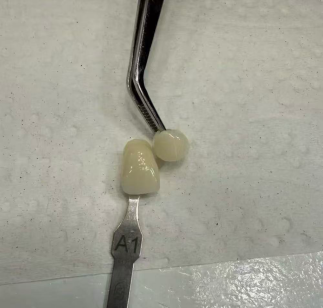
Look at the photo above. Freshly sintered crowns, held right next to an A1 shade tab — and they read pale, chalky, almost lifeless beside it. The technician did everything by the book, yet the result sits a full step too bright and too opaque to pass.
Every one of us in this industry has seen this. "Too white after sintering" is one of the most common complaints I hear, and as someone on the manufacturing side of zirconia, I want to unpack why it happens. It's that a beautiful restoration depends on a chain of variables, some living in the block and some living in the process, and this article is about reading that chain correctly.
Start by Defining What "Too White" Means
From a manufacturer's perspective, the first step is not to blame the block, the furnace, or the technician. The first step is to identify the optical signature. A crown that looks too white may have excessive value, insufficient chroma, too much opacity, or a lack of internal depth.
Sintering normally moves zirconia toward greater density and translucency. Before sintering, the milled restoration contains microscopic porosity, which scatters light and gives the blank a bright, chalky appearance. During firing, the pores close and the restoration shrinks by approximately 20-25 percent. When this process is completed correctly, light transmission improves and the material shows more depth.
So when a finished restoration still looks chalky or lifeless, it usually means one of two things: the material did not reach its expected optical state, or the color system did not express enough warmth.
Two very different signatures
Before adjusting a sintering curve or changing material brands, ask one simple question: is the crown opaque and chalky, or is it translucent but still too pale?
An opaque, cloudy crown often points toward incomplete densification, insufficient peak temperature, inadequate holding time, aggressive speed sintering, or a furnace that is running cooler than the display indicates. Residual porosity continues to scatter light, raising value and reducing vitality.
A crown with acceptable translucency but insufficient warmth tells a different story. The densification may be fine, but the shade development is weak. The cause may be material selection, pigment concentration, coloring technique, thickness, stump shade, cement shade, or finishing.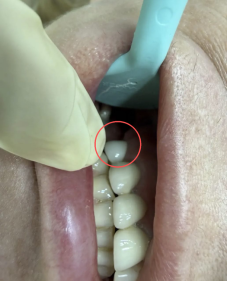
A value mismatch as it reads in the mouth: the circled restoration stands out brighter than the surrounding dentition.
These two signatures lead to different solutions. Confusing them can send a lab in the wrong direction for days. Once the signature is clear, the diagnosis becomes much more focused.
What the Zirconia Block Brings to the Result
This is where manufacturing quality becomes visible. A zirconia block is not just a white ceramic disc. Its final optics are shaped by powder chemistry, stabilizer content, pigment dispersion, pressing density, pre-sintering control, and batch consistency.
Material grade is one key factor. 3Y, 4Y, and 5Y zirconia systems do not behave the same way. Higher-strength grades mask better but can look more opaque. Higher-translucency grades can look more lifelike, but may appear too bright or weak in chroma if the case design, stump shade, or cement system is ignored.
The pigment system is equally important. Warm A-shades rely on carefully controlled colorants that must be evenly dispersed through the powder or introduced through a compatible coloring workflow. A well-manufactured pre-shaded or multilayer block should maintain stable chroma and value within the recommended sintering window.
A strong manufacturing process also provides a forgiving process window. Furnaces age, trays vary, and cases differ in thickness. Consistent particle size, uniform pressing density, controlled pre-sintering, and reliable shade calibration help the block perform predictably when small process variations occur.
What the Laboratory Process Does With It
Even a well-manufactured block can be pushed toward a white or opaque result by the workflow. Start with the sintering furnace. Heating elements age, temperature distribution changes, and the display may not reflect the actual chamber temperature. A cooler-than-expected furnace can leave zirconia under-densified, reducing translucency and increasing chalkiness.
The sintering schedule also matters. Every block is validated around a specific peak temperature, holding time, and ramp rate. Fast programs should only be used when the material is designed for them. Thick, translucent, or esthetically demanding cases often need a more conservative cycle.If the sintering temperature is too low, the zirconia may not densify completely. This can leave more residual porosity in the structure, increasing light scattering and making the restoration appear chalky, opaque, or too white.
Coloring and drying are another frequent source of shade problems. For white or partially shaded systems, expired liquid, insufficient dipping time, uneven brush application, or incomplete drying can reduce final chroma. Oils, dirty trays, carbon residue, or incompatible liquids may also disturb color development.
Design and finishing should not be overlooked. A crown that is too thick may look higher in value and more opaque. A thin crown may be influenced by stump or cement shade. Heavy glaze or an overly reflective surface can also make the restoration appear brighter.
Practical Checks Before Blaming the Material
When zirconia comes out too white, review the full chain: confirm the material grade and shade system, check the wall thickness, follow the recommended sintering curve, calibrate the furnace, control coloring and drying, avoid contamination, and compare the result under standardized lighting rather than relying on phone photos or mixed clinic light.
For manufacturers, this is a reminder that true quality is not measured only by flexural strength, translucency percentage, or a shade chart photo. It is measured by how consistently the material reaches the intended value, chroma, and translucency after sintering.


 EN
EN

