 ×
×
A screw-retained maxillary full-arch restoration milled from one ICERA zirconia blank, finished with layered pink gingival characterization and a high-gloss glaze. Case overview This case documents a screw-retained maxillary full-arch implant bridge ...

A screw-retained maxillary full-arch restoration milled from one ICERA zirconia blank, finished with layered pink gingival characterization and a high-gloss glaze.
Case overview
This case documents a screw-retained maxillary full-arch implant bridge produced from a single ICERA zirconia block. The restoration replaces a complete upper arch, carrying both the tooth form and the gingival contour in one piece of ceramic. No metal substructure was used, and no veneering porcelain was layered over the functional surfaces.
Full-arch work sits at the demanding end of what a ceramic material is asked to do. A single-unit crown fails locally. A full-arch bridge distributes chewing load across a long cantilevered span, and any weakness in the material or the fit propagates through the entire restoration. That is why full-arch cases are a fair test of a blank.
Why monolithic
The traditional approach to full-arch aesthetics was to mill a strong framework and layer feldspathic porcelain over it for translucency and colour. That method produces beautiful results, and it also produces the most common failure in the category: chipping at the interface between the framework and the veneer. The two materials have different thermal expansion behaviour and different fracture toughness, and the bond between them becomes the weakest point in the system.
Milling this case as a monolithic unit removes that interface entirely. The occlusal and incisal surfaces are zirconia straight through, the load is carried by a continuous zirconia structure rather than through a zirconia–veneer interface. For patients with a heavy bite or a history of bruxism, removing the veneer interface eliminates one common failure mode and gives the restoration a more homogeneous load-bearing structure.
The trade-off has historically been aesthetic. Early monolithic zirconia was strong and opaque, and it looked it. Blank development over the last several years has narrowed that gap considerably, and this case is an illustration of where the material now sits.


Material and workflow
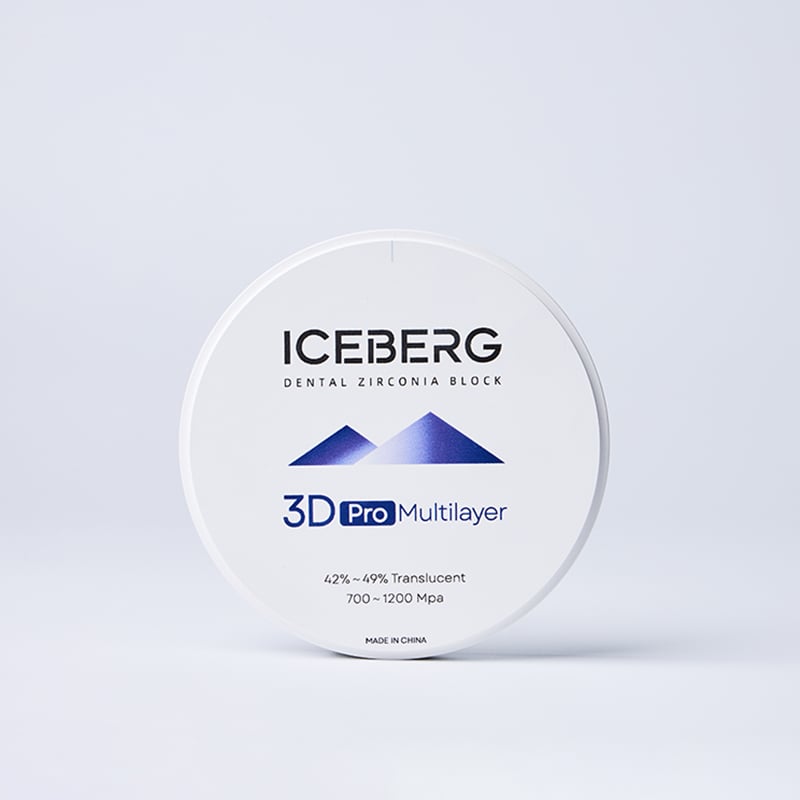
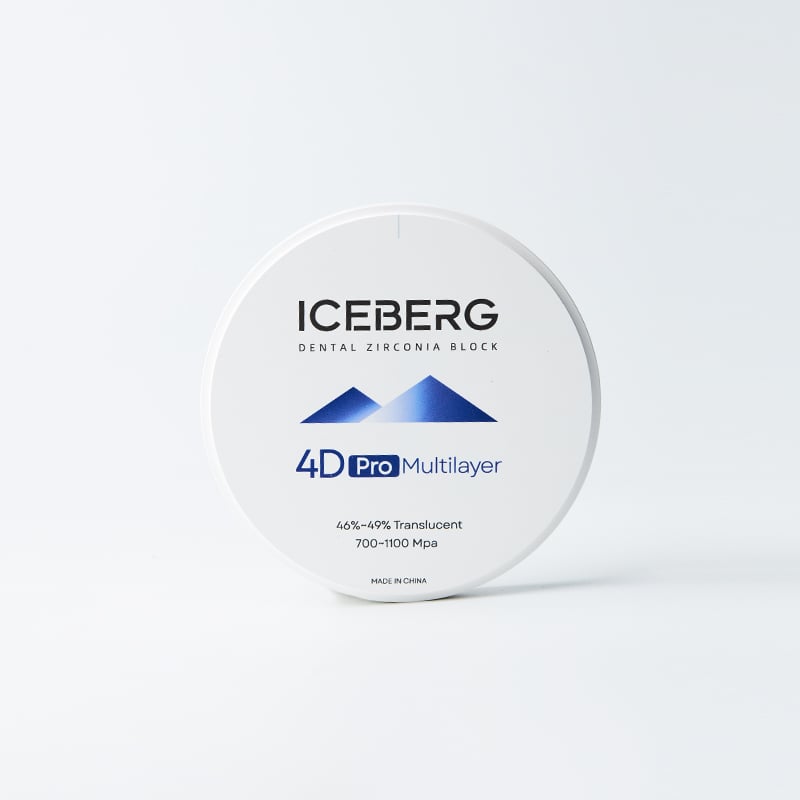
The bridge was milled from ICERA 4D Pro, selected for the combination of flexural strength and gradient translucency the case required. A multilayer block carries a built-in transition from a more opaque, chromatic cervical zone to a more translucent incisal zone, which means part of the optical work is already present in the material before any staining begins.
The design was completed digitally from the scan data, with the screw channels positioned to emerge palatally where they would not interfere with the labial surfaces. Milling was performed in the pre-sintered state, followed by sintering at cycle. Shrinkage compensation was applied at the design stage, and the fit on the multi-unit abutments was verified after sintering before any finishing work began.
Passive fit matters more here than anywhere else in prosthetics. A bridge that seats under tension transfers that tension into the implants and the surrounding bone continuously, not just at the moment of insertion. Verification before staining avoids discovering a fit problem after hours of aesthetic work.
Gingival characterization
The pink work was kept deliberate rather than heavy. Stain was applied to the gingival zone in graduated intensity, denser toward the cervical margins and thinning as it approaches the tooth form, so the transition reads as depth rather than as a painted boundary. Where the pink meets the tooth, the edge was feathered rather than defined, which is what prevents the restoration from looking like two materials joined together.
The tooth shade is high value with natural incisal translucency, visible in the photographs as the slightly greyer, more transparent band at the incisal edges. That translucency is what stops a bright shade from reading as flat and artificial under intraoral lighting.
Surface finish
After glazing, the surface reaches a dense, smooth finish with the light behaviour visible in the close-up images. This is not only cosmetic. A dense, smooth zirconia surface reduces surface roughness and makes plaque retention and staining more difficult. Full-arch restorations are difficult for patients to clean around, so a surface that resists biofilm has real clinical value across the years the restoration is in service.
Zirconia also offers high chemical stability in the oral environment and is highly resistant to corrosion and dissolution under normal clinical conditions.

What this case demonstrates
Full-arch work is where material quality becomes visible. The strength has to be genuine, the shade gradient has to be built into the blank rather than painted on afterward, and the sintering behaviour has to be predictable enough that a fourteen-unit span comes out of the furnace fitting the way it was designed to fit. This case was produced entirely from ICERA material.


 EN
EN